


Philosophy & Hope Bookclub 5: The Utopia of Rules
- Time:
- Monday, 13 July 2026 : 19:00 - 20:30
Book Now
Reserve Free Seat
Buy the book below and use your book club discount!
Welcome to Lighthouse’s Philosophy Bookclub, where we will be reading contemporary philosophers that concern themselves with the social!
The overarching theme will be readings that engage in social critique that can help take us towards new forms of social hope. We will be reading authors that offer powerful critiques of institutions, big tech, political concepts, and late-stage capitalism that, ultimately, seek to re-evaluate the now in order to re-envision the future.
Why Philosophy & Who's This For?
Philosophy is first and foremost a social activity – it’s about thinking together in communities of inquiry, it’s about synthesising ideas, transforming the categories and concepts which guide our thinking. It is famously characterised as a space “to understand how things in the broadest possible sense of the term hang together in the broadest possible sense of the term” as one philosopher put it.
This bookclub is for both philosophers and non-philosophers alike! For the philosophically initiated, the readings will be contemporary thinkers who you won’t find on a typical reading list. For the uninitiated, these readings will also be highly accessible, short, and relevant to the world we find ourselves in today. It's an inclusive reading club, welcoming as many people from as many different backgrounds to help give us the best chance of seeing how everything hangs together!
Meetings:
Meetings will be hosted by Nic and take place every 5-6 weeks on Monday at Lighthouse from 7pm-8:30pm.
Use the code HOPE-PHILOSOPHY-SOC to get 10% off the bookclub books!
What We Are Discussing This Month:
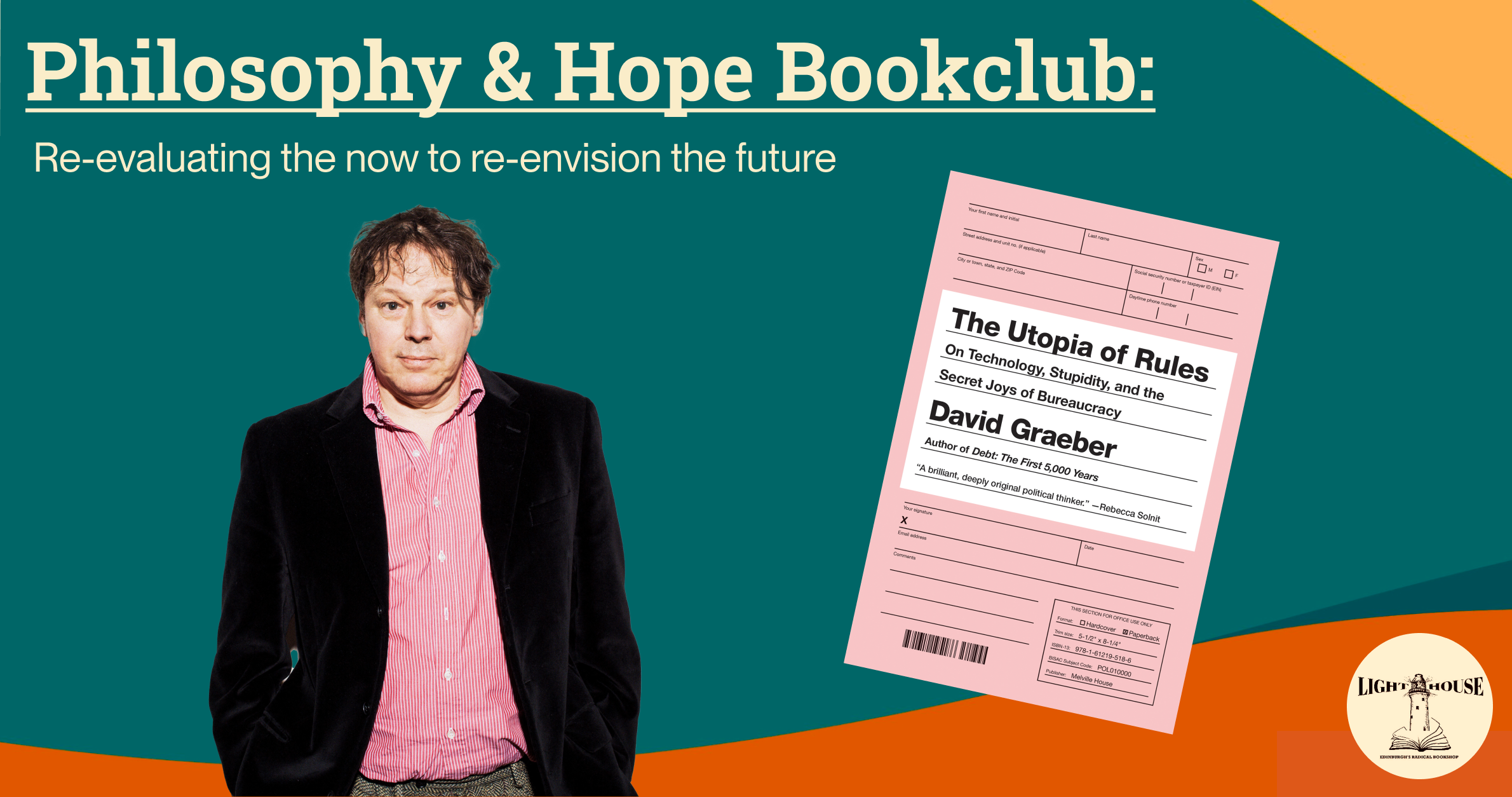
The Utopia of Rules: On Technology, Stupidity, and the Secret Joys of Bureaucracy by David Graeber Where does the desire for endless rules, regulations, and bureaucracy come from? How did we come to spend so much of our time filling out forms? To answer these questions, anthropologist David Graeber – one of the most prominent and provocative thinkers working today – takes a journey through ancient and modern history to trace the peculiar and fascinating evolution of bureaucracy over the ages. He starts in the ancient world, looking at how early civilizations were organized and what traces early bureaucratic systems have left in the ethnographic literature. He then jets forward to the nineteenth century, where systems we can easily recognize as modern bureaucracies come into being. In some areas of life – like with the modern postal systems of Germany and France – these bureaucracies have brought tremendous efficiencies to modern life. But Graeber argues that there is a much darker side to modern bureaucracy that is rarely ever discussed. Indeed, in our own “utopia of rules,” freedom and technological innovation are often the casualties of systems that we only faintly understand. Provocative and timely, the book is a powerful look and history of bureaucracy over the ages and its power in shaping the world of ideas.