
Reimagining Colonised Landscapes Book Club: The Kurdish Women's Movement
- Time:
- Sunday, 26 April 2026 : 17:00 - 19:00
Book Now
Reserve Free Seat
Buy the book below and use your book club discount!
The Reimagining Colonised Landscapes Book Club will meet monthly.
This reading group aims to create a space for collective reflection and discussion on colonialism, decolonisation, power, resistance, and knowledge production.
Through non fiction texts, we will examine the historical, political, and social contexts of selected books, discussing how these texts resonate with the present, what they represent for whom, and how they can be read.
Meetings are open; anyone interested may join in any meeting. Regular attendance is not mandatory, and if you have only managed to read part of the book or even a couple of chapters, we would still love for you to join us for a discussion.
Due to the sensitivity of the topics, participants are expected to approach the discussion with respect, attentive listening, and careful language. This space is geared toward learning, questioning, and collaborative thinking.
Each session will focus on the following topics related to the book:
- The accessibility and comprehensibility of the text
- Its relevance to contemporary contexts
- How it intersects with different experiences and perspectives
- The discussion will mainly revolve around these topics.
Book club members get 15% off book club books with the code DECOLONIAL-LANDSCAPE-BOOKS.
This meeting will be in-person in the bookshop, from 5-7pm.
The book
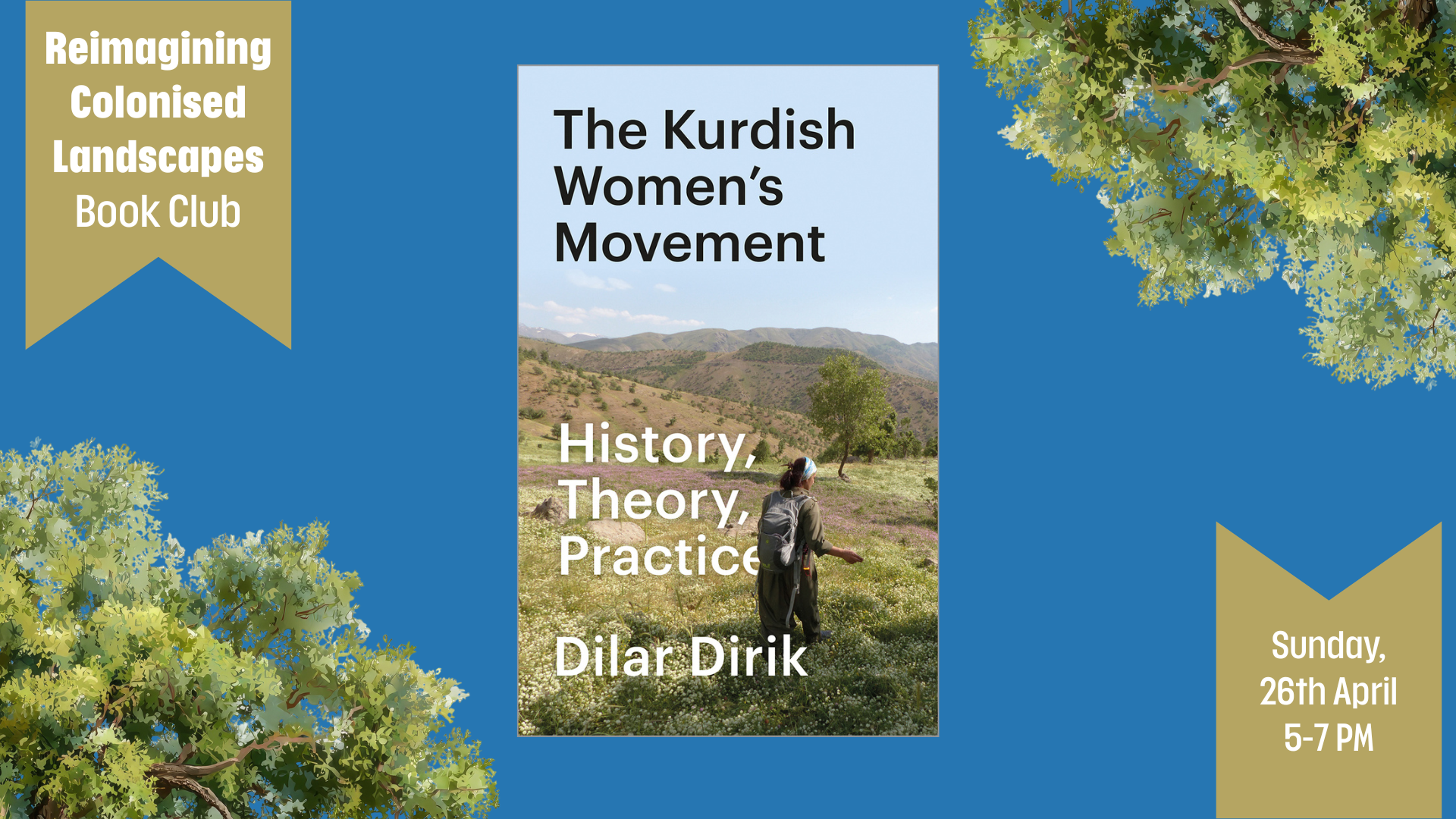
The Kurdish women's movement is at the heart of one of the most exciting revolutionary experiments in the world today: Rojava. Forged over decades of struggle, most recently in the fight against ISIS, Rojava embodies a radical commitment to ecology, democracy and women's liberation. But while striking images of Kurdish women in military fatigues proliferate, a true understanding of the women's movement remains elusive.
Taking apart the superficial and Orientalist frameworks that dominate, Dilar Dirik offers instead an empirically rich account of the women's movement in Kurdistan. Drawing on original research and ethnographic fieldwork, she surveys the movement's historical origins, ideological evolution, and political practice over the past forty years. Going beyond abstract ideas, Dirik locates the movement's culture and ideology in its concrete work for women's revolution in the here and now.
Taking the reader from the guerrilla camps in the mountains to radical women's academies and self-organised refugee camps, readers around the world can engage with the revolution in Kurdistan, both theoretically and practically, as a vital touchstone in the wider struggle for a militant anti-fascist, anti-capitalist feminist internationalism.